
TrainingYanuar Dwie
FTHR - Functional Threshold Heart Rate

Why does threshold heart rate matter for runners?
Plenty of runners, beginners and experienced alike, train without really knowing their own limits. So they either end up training so hard they overtrain, or training so easy that progress stalls.
One way to make sure your training matches what your body can handle is to do a Functional Threshold Heart Rate (FTHR) Test. The test helps you set training zones based on heart rate, so every session is more effective and more focused.
Once you know your FTHR, you can:
✅ Avoid overtraining and lower your injury risk.
✅ Set the right training intensity for the results you want.
✅ Track your progress more objectively.
What is Functional Threshold Heart Rate (FTHR)?
Functional Threshold Heart Rate (FTHR) is the highest heart rate you can hold steadily for 1 hour. It’s closely linked to your Lactate Threshold (LT), the point where your body starts to build up lactate faster than it can clear it.
FTHR is not the same as Max Heart Rate (MHR)
Max Heart Rate (MHR) is the highest heart rate your body can reach.
FTHR is more useful for training because it marks the upper limit you can work at before fatigue sets in from the rising stress on your muscles.
How to do the FTHR test
The good news: you don’t have to run flat out for a full hour to find your FTHR. It can be estimated in just 20 minutes, like this:
The FTHR test, step by step
1. Warm-up
✅ Do an easy run for about 10 minutes or longer, depending on how your body feels.
✅ Add some dynamic stretching or running drills.
✅ Then rest for 2-3 minutes before you start the test.
2. The 20-minute test
✅ Run at the hardest effort you can hold for 20 minutes.
✅ Make sure you don’t start too fast, so you can keep a steady rhythm.
3. Recording the data
✅ When you’re done, take your average heart rate over the 20 minutes as the key number.
✅ Calculate FTHR: 95% of your average heart rate over the 20 minutes.

💡 Key tips
Do the test on a treadmill or a track, so hills and traffic don’t get in the way.
Record it on a sports watch. An external HRM (heart rate monitor) is recommended for a more accurate reading.
Setting training zones from your FTHR test
Once you know your FTHR, the next step is to set your training zones as percentages of FTHR.
Zone 1: Recovery < 68%
Zone 2: Endurance 69 - 83%
Zone 3: Steady State 84 - 94%
Zone 4: Lactate Threshold 95 - 105%
Zone 5: VO2 Max > 106%
Case study: Ryan’s training zones from FTHR
After a 15-minute warm-up of easy running that built up gradually in intensity, Ryan ran a 20-minute test at the hardest effort he could hold steadily. Here are his results:
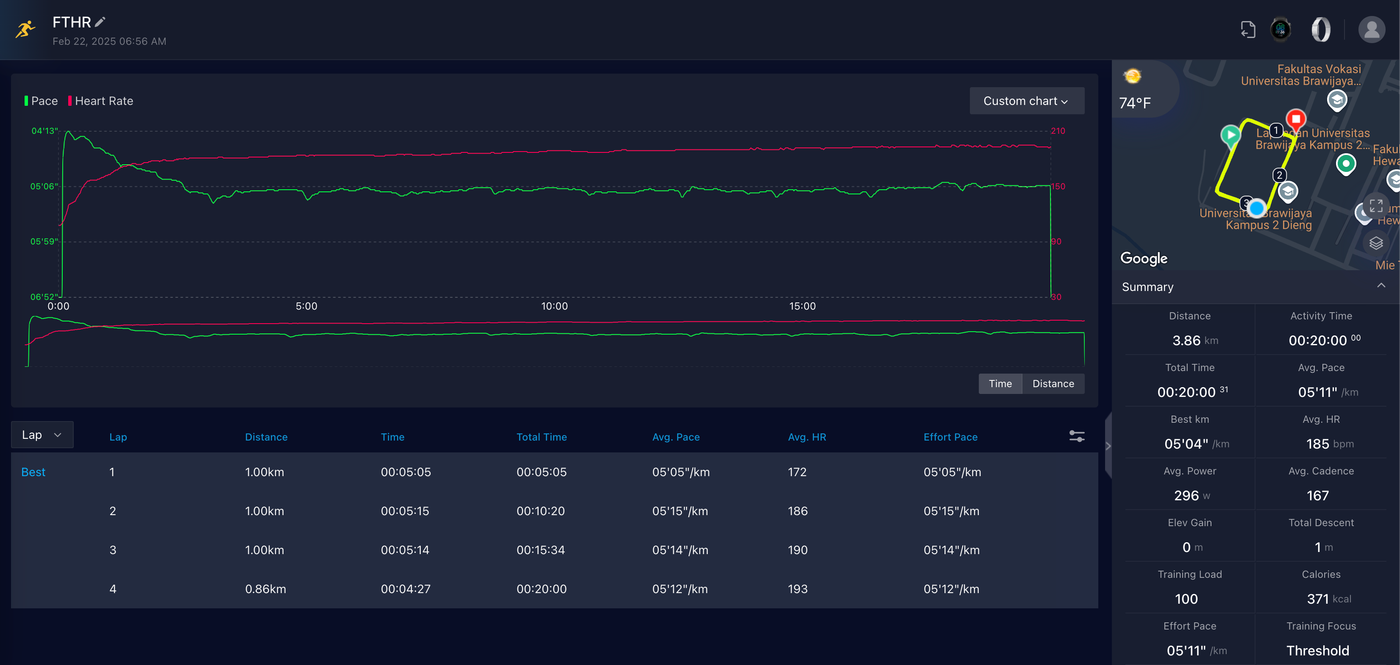
Average heart rate (20 minutes): 185 bpm
FTHR (95% of average HR): 176 bpm
From there, Ryan’s training zones work out like this:
Zone 1: Recovery (< 68%) : < 120 bpm
Zone 2: Endurance (69 - 83%) : 121 - 146 bpm
Zone 3: Steady State (84 - 94%) : 148 - 165 bpm
Zone 4: Lactate Threshold (95 - 105%) : 167 - 185 bpm
Zone 5: VO2 Max (> 106%) : > 187 bpm
With accurate FTHR data, Ryan can fine-tune his training and also:
Prevent overtraining by knowing when to push hard and when to recover.
Set training intensity by heart rate, not just by how he feels.
Track progress by comparing his FTHR every few months.
Want more focused training, like Ryan?
Do the FTHR test now and use your training zones to get more out of your running.
🔢 Use our FTHR calculator to work out your Threshold Heart Rate and training zones right away.
💬 Still unsure, or want to talk it through? We’re happy to help. Get in touch here for more personal guidance.
Training notes.

Training
S.M.A.R.T Goals

Featured
"Untitled Ultra"