
FeaturedYanuar Dwie
Know Your Running Goals

Photo by Jihaz (@pluieenjanvier)
Goals are a key part of planning. In running, especially when you’re putting together a training plan, having goals helps you grow as a runner. Without them, your motivation to stick with the plan can fade. Or even if you stay motivated, your training may lack structure or focus because it isn’t aimed at anything.
In this article, we look at a few types of goals that runners can use.
Types of Goals: Process, Performance, Outcome
When you plan and follow a training program, goals fall into three types: Outcome, Performance and Process Goals.
1. Outcome Goals
Outcome goals focus on the end result you want, like winning a race, making the podium or setting a personal best over a certain distance.
But outcome goals are the kind of goal that’s often affected by things outside your control, like the weather, an injury during the race, a change to the race course, and anything else that can stand between a runner and a personal best.
When some runners miss their outcome goals, they get frustrated and stressed. That’s not a good place to be, because it can sap their motivation for the next training program.
2. Performance Goals
Performance goals focus more on effort the runner can control. They still have a specific target, but these goals are more flexible than outcome goals.
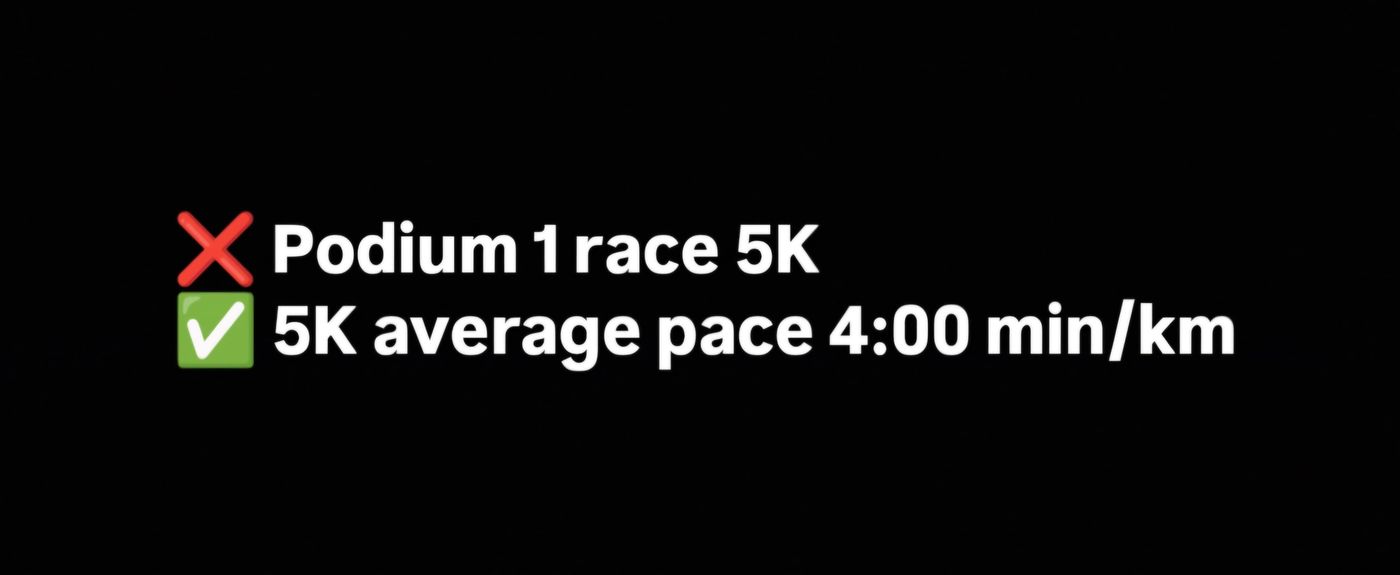
If an outcome goal might be something like ‘Win a 5 km race’, a performance goal could be ‘Race 5 km at an average pace of 4:00 min/km, and keep trying to push if the last part of the race feels hard’.
3. Process Goals
Process goals are the most controllable kind of goal, because they focus on habits and daily or weekly training. Hitting your process goals gives you the best chance of reaching your outcome goals.
Examples of process goals include how many days a week you train, how long or how much you train, and which intensity sessions go into your training cycle.
Conclusion
Here’s an example of how the 3 types of goals work together:
Outcome goals: A podium at a local race over the half marathon distance.
Performance goals: Execute the race plan, from pacing to fueling. Stay with the group that could finish in the top 3 for the whole race.
Process goals: weekly mileage, a speed session program, the long run, strength training and nutrition over a 16-week training plan.
Setting goals gives your training direction. Without goals, training can lose focus and the results won’t be consistent.