FeaturedYanuar Dwie
Mantra 116 - 68K Training Story: 20 Weeks of Building Consistency & Specificity

Cover image credit: @fadhlimotret / @mantra116.id
After benchmarking with “Untitled Ultra”, Ryan started a 20-week training block to prepare for one of his goal races this year: Mantra 116 - 68K. The main factors behind the training plan were:
- Mantra 34K 2024 finish time: 10:11:39
- Weekly mileage before the program: 50 km
- Main strength: Endurance
- Area to work on: Speed
Training periodization
The training block was split into five main phases:
- General Conditioning (4 weeks): Building a speed foundation
- Base Fitness (5 weeks): Speed and endurance
- Build Fitness (6 weeks): Volume and specific training
- Peak (2 weeks): Race simulation
- Taper (3 weeks): Lower volume, keep the intensity
The early focus was on building speed, the weakest area, through intervals, tempo runs and hill sprints. Meanwhile, endurance was kept sharp with steady-state runs, long runs and hill repeats.
Program structure
Training followed this weekly pattern (microcycle):
- Monday: OFF
- Tuesday: Quality session + gym
- Wednesday: Easy run
- Thursday: Quality session + gym
- Friday: Easy run
- Saturday: Long run / trail
- Sunday: Easy run
Gym sessions went on the same days as quality sessions to stack the training stress, so the easy run days could really be used for recovery.

Weekly load
Training principles
General principles
Across the 20 weeks, the training principles focused on:
- Easy runs guided by heart rate (HR)
- Quality sessions guided by pace or perceived effort
Heart-rate zones were set with a Functional Threshold Heart Rate (FTHR) assessment in weeks 1, 8 and 19. Running easy days by HR helps keep the runner in the aerobic zone and away from overtraining.
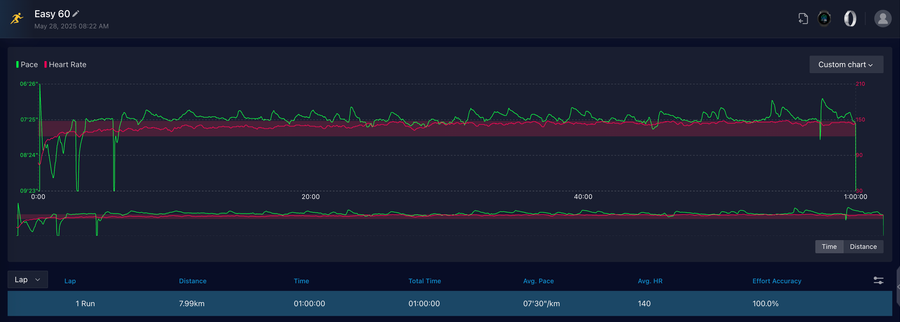
Heart-rate data from easy runs
Race-specific principles
The specific training was built around the Mantra 116 - 68K race profile: 68 km, 5,000 m of elevation and a 22-hour cut-off. Some of the specific work:
- Long runs to build long-haul endurance
- Elevation work on road and trail
- Nutrition practice during long runs
Hill sessions on the road meant hill sprints, threshold uphills and long runs on rolling segments. On trail, the work happened on short, steep segments to mimic the technical sections in the first half of the race.
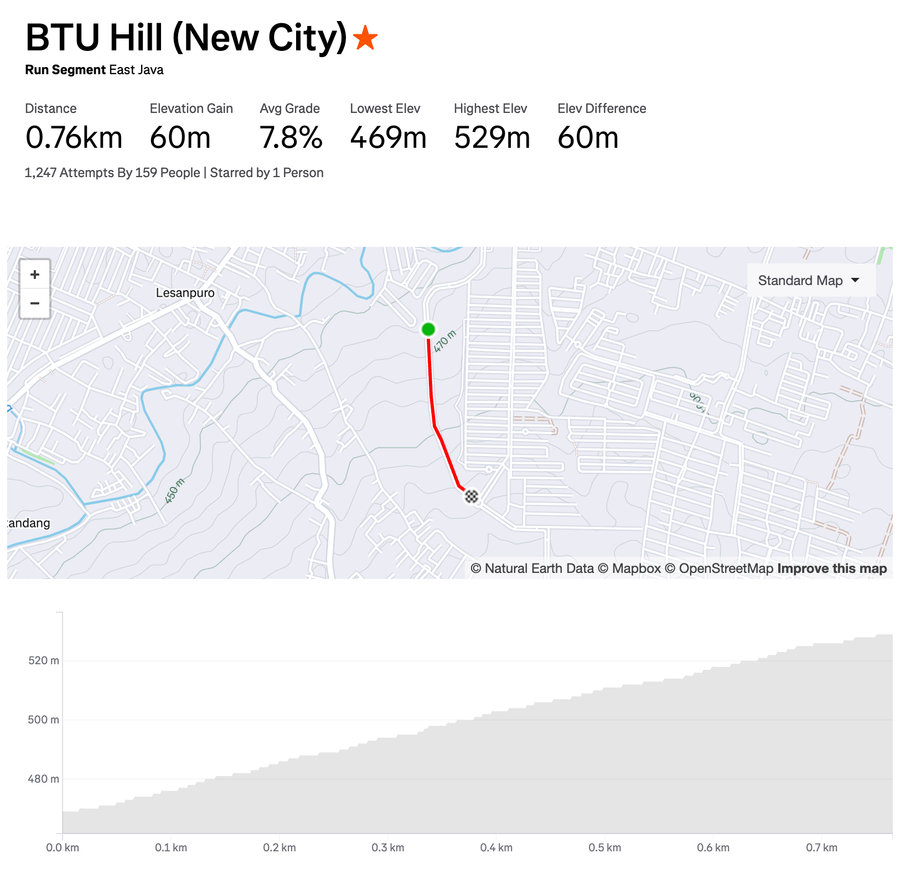
The BTU segment for hill repeats
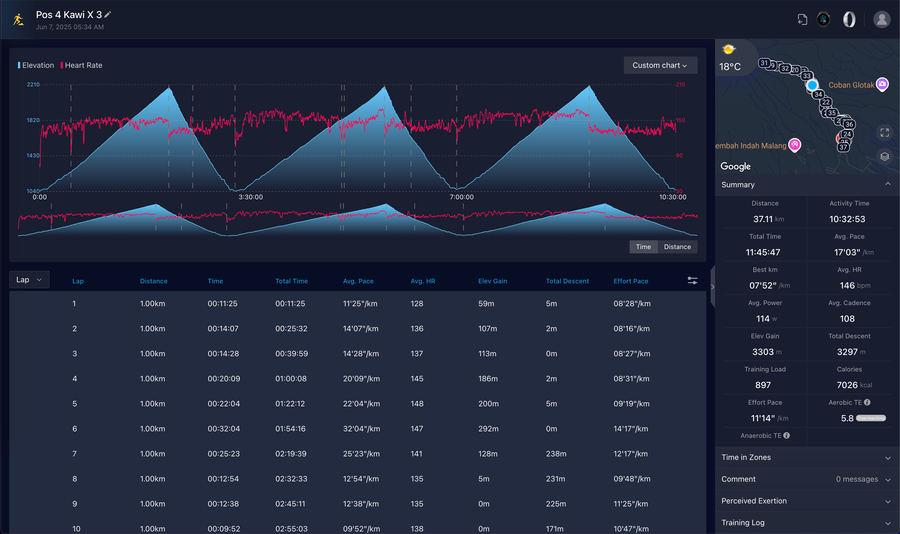
Peak training - 3 x Pos 4 Gunung Kawi
Volume & intensity progress
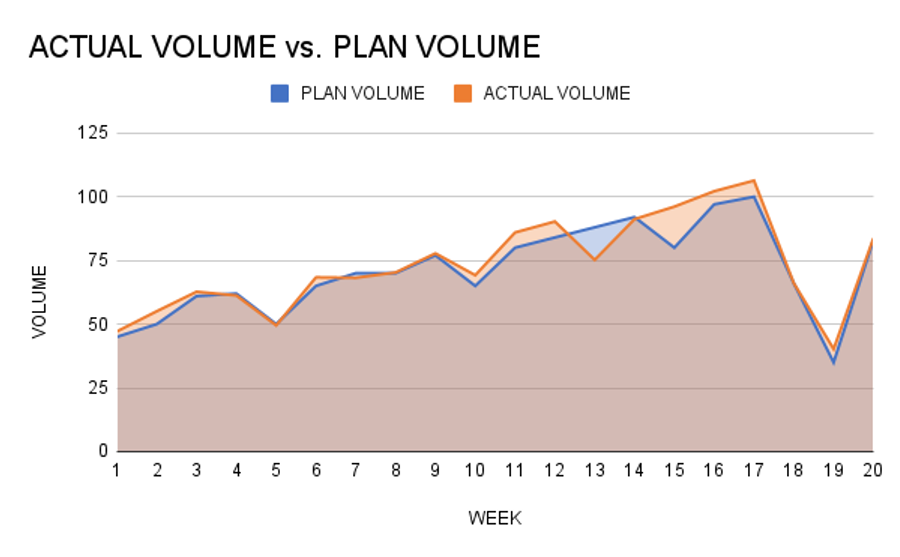
Actual Volume VS Plan Volume
Weekly volume started at 47 km and built progressively to 106 km in the peak week.
To work around limited time and raise volume efficiently, the hard days were restructured, especially Tuesdays and Thursdays.
Before, a hard day was just:
- Morning quality session
- Midday gym session
From the Build Fitness phase on, this became a triple workout:
- Morning quality session
- Midday gym session
- Evening easy run
The change was phased in gradually. The aim was to stack training stress into one day and leave more room for recovery on the days after.
Nutrition
Long runs doubled as a test of the nutrition strategy: how well regular energy intake worked, and how the body adapted to a mix of energy gels and real food.
Past experience in the full marathon showed that taking carbs at regular intervals prevents bonking. For an ultra, though, Ryan needed to add real food, for the extra calories and because it’s easier to keep eating over many hours, especially once gels start to feel monotonous and hard to stomach.
Luckily, the aid stations at Mantra are well stocked, so Ryan could shape his nutrition strategy during training and get his body used to different kinds of food for race day.
Benchmark: FTHR Test
To measure progress and readiness, Ryan did the FTHR test 3 times:
- Week 1: Measure the baseline
- Week 8: Evaluate the base fitness results
- Week 19: Check final readiness before the race
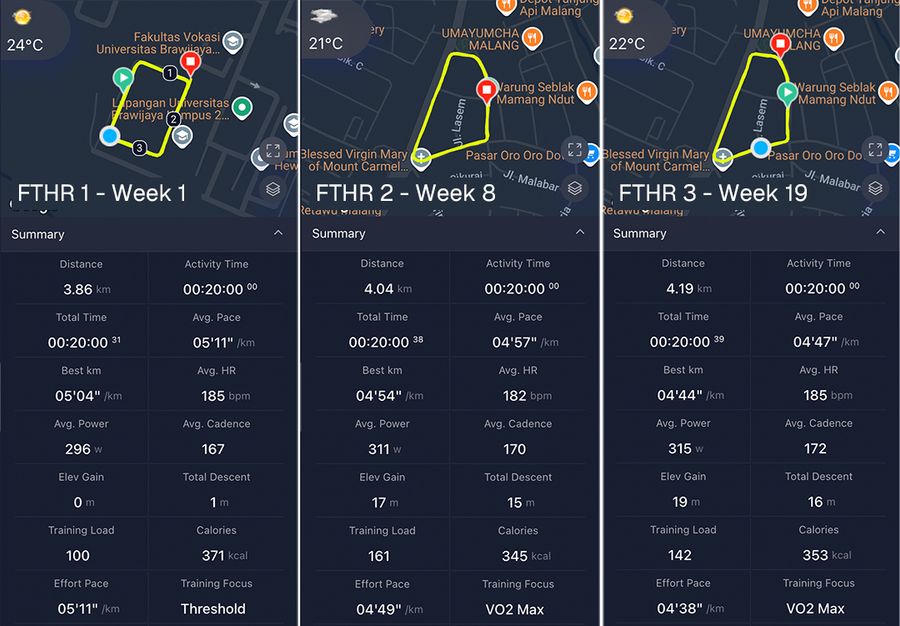
FTHR data
Challenges during training
1. Adapting to the training load
With an ultra trail race as the target, adapting to the training load was one of the main challenges. The period before had no consistent training structure, so adjusting to the volume and intensity was crucial.
The toughest phase came when the triple workouts started, which were pretty draining in the first few weeks.
“The hard days were a real struggle at first, especially once the triple workouts started. But bit by bit the routine settled in without overloading my body, even if it was still challenging.” — Ryan
2. Calf problems
Calf trouble first showed up during “Untitled Ultra” and came back on downhill sessions in trail training.
Two main approaches were used to deal with it:
- Strength training to target the calf muscles
- Adequate nutrition, especially carbohydrates and minerals
Better nutrition habits and strength work gradually eased the discomfort in that area.
This training block was the main foundation for getting Ryan ready to take on Mantra 116 - 68K. The next article covers the race strategy and how it played out on race day.
Training notes.

Featured
"Untitled Ultra"